U.S. Science’s Social Contract
Where does it stand in 2026?

Several months ago, I watched a webinar sponsored by the U.S. National Academy of Sciences, “Was Science’s Social Contract Just a Myth?”.
I found it quite intriguing – it gave some background on the idea, a trajectory on how it has unfolded over the decades, and what it might mean going forward. Hence, I decided to dig a bit deeper.
History of the tacit ‘social contract’
The idea underlying a ‘social contract’ between primarily university scientists and U.S. society dates to the end of World War II. Vannevar Bush presented a report to US President Harry Truman in July, 1945 entitled “Science – the Endless Frontier.”
The report argued for federal agencies that would fund scientific research at universities. This led to rapid expansion in the existing National Institutes of Health and creation of the National Science Foundation in 1950. Bush’s argument was that if the country nurtured cutting-edge basic science, inevitably new technologies would arise with impact on economic growth and job creation, national security and improved health even in the absence of an explicit national industrial policy targeted to those ‘goods.’ The tacit social contract with scientists was that they would be provided with a large degree of self-governance and financial support with no strings attached for basic research. In the last 25 years, we have seen the development of pluripotent stem cells, mRNA vaccines, CRISPR gene editing, personalized medicine, therapeutic use of monoclonal antibodies etc. All of these technologies arose from fundamental biological science research.
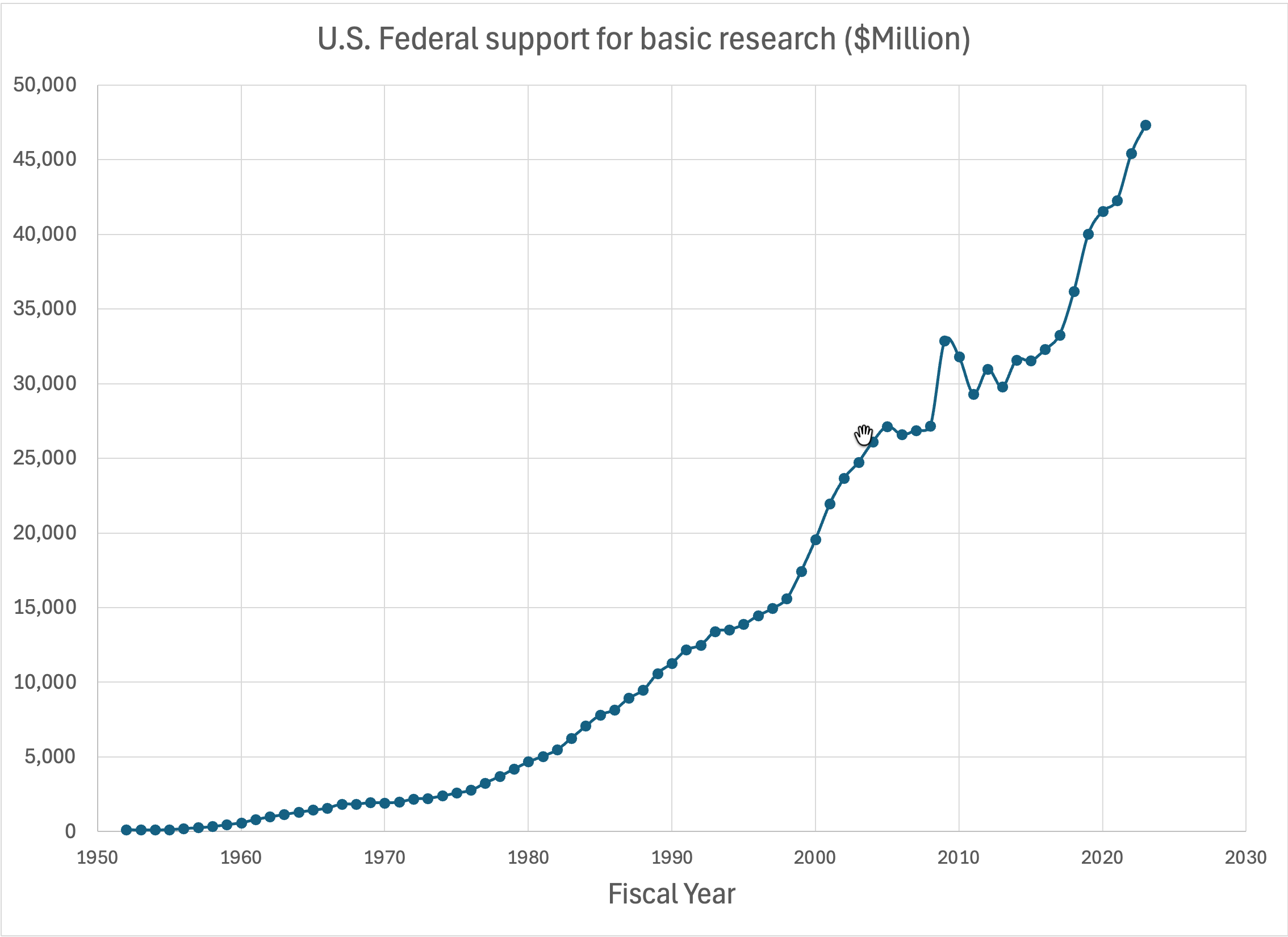
In principle, this social contract in the United States applies to basic research funded by the federal government. The National Science Foundation tallies all Research & Development (R&D) – public and private -- that occurs every year. Here are the increases in federally-supported basic research over the last 75 years.
Several points about R&D in the United States
• Basic research historically was mostly undertaken by faculty at universities. However, now only about 50% occurs there and 30% is performed in the business sector.
• Funding for basic research has ranged from 0.1-0.5% of U.S. Gross Domestic Product over the past 50 years.
• Applied research monies have had a similar temporal trajectory but are about 120% of basic research expenditures each year.
• Research funds are dwarfed by Development (“systematic use of the knowledge or understanding gained from research, directed toward the production of useful materials, devices, systems, or methods, including design and development of prototypes and processes.”). Development comprises two-thirds of the $1 trillion R&D spending in 2024.
• About 75% of U.S. R&D takes place in the business sector – most of it in “Development”.
• U.S. federal spending on R&D is dominated by the Department of Defense at ~$185 billion. NIH is by far the next largest supporter of R&D (at $48 billion) but it and all other federal agencies are only 25% of DoD expenditures.
Anecdote #1: I began as an assistant professor at Purdue in 1977. My senior colleagues would regale me with stories from the 1960s how program officers from NIH would call them and beg to submit grant proposals so that they could fund them. Things were already different at the time I began. When I saw that my lab-neighbor Ed Umbarger, a National Academy of Sciences member, was sweating over renewal of his NIH grant, I knew that it would be a slog for me.
The panelists on the NAS webinar all agreed there have been large changes in the basic science enterprise and the public’s perception of it. I see two major changes. One is a diminution of ‘pure’ basic science for mission-oriented funding programs not only in agencies like the Department of Energy and U.S. Department of Agriculture but also in NSF.
Anecdote #2: I knew a scientist, Anna Palmisano, who went on to become a program manager at the Office of Naval Research and Department of Energy. We were having a conversation in the early 1990s and I was decrying the difficulty in getting funding for ‘pure’ science. Anna’s retort was that when research funds are limiting, the taxpaying public has an expectation that they will be directed towards problems of most interest to them. This of course goes against the grain of Vannevar Bush’s argument but I think hers is also a valid point.
This is very U.S.-centric. I have no knowledge whether ‘social contract’ resonates in other countries. I would love to read comments about the situation in other countries.
Scientists and the public policy fray
The second part implicit in the “social contract” was that science was to be a search for “truth” outside of political power. Under the current U.S. administration that wall has been breached – Science is subject to political abuse and there are many bad actors out there willing to spread misinformation to advance their political agenda. But even before this, it was naïve to think that scientists would not get caught up in disputes over government policies – at the inception of this ‘social contract’ the theoretical physicists Robert Oppenheimer and Edward Teller were heavily involved in pushing their own agendas regarding the use and future development of nuclear weapons. This becomes problematic when scientists go beyond articulating upfront that they are advocates for a particular policy position and their science itself becomes colored by their advocacy. This leads to an erosion of public trust in science.
Certainly public mistrust is widespread for American institutions, but two issues – one acute and one multi-decadal have been particularly important for science: the responses to the COVID-19 pandemic and climate change.
With respect to COVID-19, my thoughts remain similar to a year ago.

It was necessary to make quick decisions in the absence of much ‘hard’ scientific evidence. But things like the 6-foot social distancing rule and mechanism of respiratory virus transmission could have/should have been intensively researched in the 100 years since the 1918 Influenza pandemic. In particular, the 6 foot rule just “sort of appeared” (Anthony Fauci testimony to Congress) – if it were 3 not 6 feet (for which there is very little difference for aerosols), schools could have remained open. There has been a very large social cost for school closures. I have seen very little that gives me confidence that the U.S. (or the world) is preparing better for the next (inevitable) epidemic/pandemic. In fact, that erosion of trust, fueled by the pseudo-science of our current Health and Human Services secretary, has led in the U.S. to lowered vaccination rates with consequent outbreaks of diseases like measles.
My trust in public dissemination of science also declined at the inception of the pandemic. As I was retired, I had the time to run down claims made in New York Times articles about COVID-19 by reading their basis in the scientific literature. It was far too common that the scientific manuscript made an exciting claim that was not supported by the data, and the journalist accepted this claim at face value. In my opinion, this is the synergistic consequence of scientists seeking to increase their visibility by high-impact claims and journalists seeking to increase their visibility with sensational reporting.
A broad-based problem layered on top of this is the increase in scientific fraud over the past few decades. Elisabeth Bik in particular has done heroic work in this area. Her 2016 paper found about a 10X increase in the proportion of papers with image manipulations from the late 1990’s to the mid-2010’s. Sabel et al. (2025) have used a red-flag method to intuit that about 6% of biomedical publications in 2023 were likely fake. Pressures to publish are pervasive in scientific fields and throughout the world. Paper mills have arisen particularly over the past 15 years and are a part of the problem. The traditional gatekeeper system (peer review) is under tremendous strain from the volume of manuscripts submitted; furthermore it was not designed and cannot effectively eliminate fraud.
Once I had been sensitized to the handling of new science in the media, I started looking differently at news reports regarding other policy issues such as climate change. To be upfront about my views – there is no doubt that the burning of fossil fuels has led to sharp increases in atmospheric CO2 recently at a rate of ~3 ppm per year. Simple bookkeeping of fossil fuels extracted and amounts burned demonstrate that 38 billion metric tons of CO2 were released in 2024. About 50% adds to atmospheric concentration increases and we infer ~25% becomes dissolved in ocean water, thereby acidifying this habitat.
Although from first principles it is irrefutable that elevated CO2 will lead to Earth warming, accurately projecting the consequences of warming is a difficult exercise. This is often done via ‘what if’ scenarios in Global Circulation Models. I heard the authors of these models discussing them about 15 years ago, and what struck me was how difficult it was to analyze why, when and where GCM models differed from each other, due to the long run times and inadequate granularity. That remains true in 2026 -- running the Standard CMIP6 requires about a month for 100 year projection and significant physical (cloud dynamics, ocean currents) and systemic (feedback loops) are poorly implemented. Here is a nice microbially-relevant assessment of difficulties in parameterizing such models.
Hence, I am skeptical when I see newspaper articles such as this: “Weather extremes gripping US bear climate crisis ‘fingerprint’, experts say.” I understand that scientists-as-citizens may have very strong views on rising CO2 levels as an existential crisis for the planet, but I think Science’s standing is imperiled when imprecise methodologies are pushed beyond their limits to ‘prove’ that a particular policy is necessary. Advocacy for policies is fine, as long as it is tempered by a commitment to being an Honest Broker of Policy Alternatives.
Three last thoughts brought up in the NAS forum
That the scientific enterprise is all about the pursuit of truth is a heartwarming idea, but it doesn’t match the lived experience of junior and senior scientists in the profession. We can see it in the stressors that lead to declines in mental health from graduate students to the professoriate. That truth-seeking premise has little to do with how university faculty are hired or how they are evaluated for promotion.
Science as an enterprise needs to do better in recognizing where it can have negative impacts on society -- an example was the Obama administration’s pause in gain-of-function research in 2014 after the laboratory creation of an H5N1 avian virus that capable of airborne transmission between mammals. An excellent example of a proactive approach was the Asilomar Conference on Recombinant DNA in 1975 where scientists voluntarily paused their work until they could produce guidelines for safe use. The issues are often thorny as regulation may slow individual scientist’s progress but that does not absolve Science as a whole from responsibility. This statement from a 2017 report from the U.S. National Academy of Sciences summarizes the dilemma:
“There is a recognition among some leaders in the scientific community of an informal social contract wherein scientists as individuals and the international scientific community have a shared responsibility, together with other members of society, to do their utmost to assure that scientific discoveries are used solely to promote the common good. This premise is not, however, accepted by all scientific practitioners.”
3. Heather Douglas articulated her ‘taxonomy’ of research with 5 nodes that can receive public funding:
Curiosity-based research (often referred to as “basic” or “fundamental”).
Engaged public research involves collaboration with specific communities or stakeholder groups that have a direct interest in the research outcomes. “This is the single-most underfunded category, and also the kind that builds the most public trust,” Douglas said.
Mission-directed research focuses on solving clearly defined problems, often tied to public priorities such as health, energy, or national security,
Regulatory research generates evidence that is directly used to inform policy, standards, and compliance decisions
Big-science research infrastructure
Douglas has interesting suggestions regarding Basic Research. It is virtually impossible to predict which projects will yield novel discoveries – and analysis indicates that grant panels are adverse to funding ‘risky’ research that might produce such discoveries. Hence, Douglas proposes funding screened lotteries for this category – awards would be smaller but more widely distributed, administrative burdens on principal investigators (shorter proposals) and reviewers would be reduced. This would make it more difficult for a principal investigator to engage in long continuous runs of funded curiosity-based research . I am ambivalent about her idea – but it does preserve scientific freedom for basic research while acknowledging the inherent unpredictability of major discoveries.
Anecdote #3: Norm Pace and his colleagues developed the use of 16S rDNA gene sequences to characterize ‘who’s there’ in natural microbial communities. Norm told me that he never was awarded a grant for these studies – he just used start-up funds he got whenever he was recruited to a new institution.
Final reflections
I began this post on the social contract with the thought that the burdens were light on the scientists – just pursue ‘truth.’ But I come to realize that the burdens are substantial and not easily resolved. Science (and scientists) inevitably become part of public policy debates. What is in the best interest of an individual scientist (looking for position and prestige) may not match what is best for society and hence requires strongly principled individuals. A standard comment years ago at scientific conferences was “I believe your data but not your conclusions.” But the rise of publication fakes suggests a deterioration in this moral code that we had heretofore assumed everyone followed. I admit that I am at a loss how to remedy this.
I am also at a loss regarding how to increase the U.S. public’s trust in Science. It is Kafkaesque that we have a Secretary of Health & Human Services who believes he can look at children and determine they have ‘mitochondrial challenges.’ Social media are rife with posts like this from self-proclaimed experts:
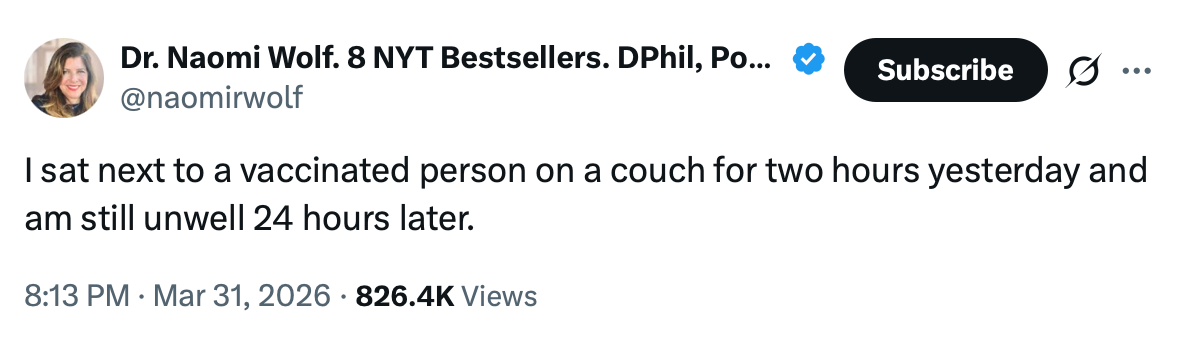
About 50% of replies mock her, but the other half clearly believe in this and that mRNA vaccines causes ‘turbo cancer.’
These bad actors will misuse whatever scientists say, but I still believe that the long game is for scientists to be scrupulous and self-critical regarding predictions, and for institutions to respond to the public’s legitimate interests at the nexus of science and policy decisions.
Today’s Moment of Zen
My wife Nancy and I ventured into Washington D.C. a week ago as the cherry blossoms were at peak bloom. Nancy got to spend 30 minutes walking around the Tidal Basin reveling in their glory, while I spent 30 minutes looking for a parking spot nearby! Finally found one about a mile away and met up with her — this is hardly unique subject matter for a photo, but I liked the gradients of light and dark in the image.