
Ay! Ay! Ay! A.I.
AI in Biology/Microbial Ecology

I read Elliot Hershberg’s excellent summary of the 2026 Cold Spring Harbor Symposium in Quantitative Biology: AI in Biology. I must confess that I have mostly ignored AI to this point – I am not competent to distinguish the hype from substance. I did have some thoughts on machine learning applied to microbial ecology and dove into the premier working example of AI in biology, Alpha Fold.
The symposium was populated by a number of enthusiastic and highly competent scientists. Much of Hershberg’s summary was not on topics of particular relevance to microbial ecology. However, I did note his report on Pushmeet Kohli’s talk. I can do no better than to quote from Hershberg’s blog post:
“The last third of his talk focused on DeepMind’s efforts to build an AI Co-Scientist, which they published a new paper on last month. Given a research goal by a human scientist, this system develops a research plan and then kicks off a “tournament” of agents competing to develop new hypotheses. Agents within this system have different tasks. Some are designed to “reflect” on the ideas being generated. Others are tasked with “evolving” them.”
There is at least one practical example of how this worked. DeepMind partnered with Jose Penades, a microbiologist who works on capsid-forming phage-inducible chromosomal islands (cf-PICIs). The lab knew that helper phages were important not only to induce new particles but also to provide the phage tails necessary to infect other cells. What puzzled them was that rather than a narrow host range, cf-PICIs were found in a broad range of taxa – from Gammaproteobacteria to Bacillus sp. to perhaps Actinobacteria. They carried out a series of experiments and concluded that cf-PICIs released tail-less capsids but used tail adaptor and connector proteins to interact with phage tails released from other cells (and including those from other bacterial species) in the extracellular milieu.
What was crucial for a test of CoScientist was that the Penades group had submitted a manuscript on this work but that information was not in the public domain (and hence not accessible by an AI agent). From a video interview of Penades at the CSHL symposium: he was excited because
“not just that the top hypothesis that they provided was the right one, it was that they provided another four and all of them made sense. For one of them, we never thought about it, and we are now working on that.”
Penades et al. (2025) published the results of this ‘experiment’ here:
AI mirrors experimental science to uncover a mechanism of gene transfer crucial to bacterial evolution
In it, they document the preliminary information provided to the agent (all of which was in prior public domain) and the research directions the agent developed. Here is their table of 6 proposed research directions and a brief idea of underlying hypotheses:
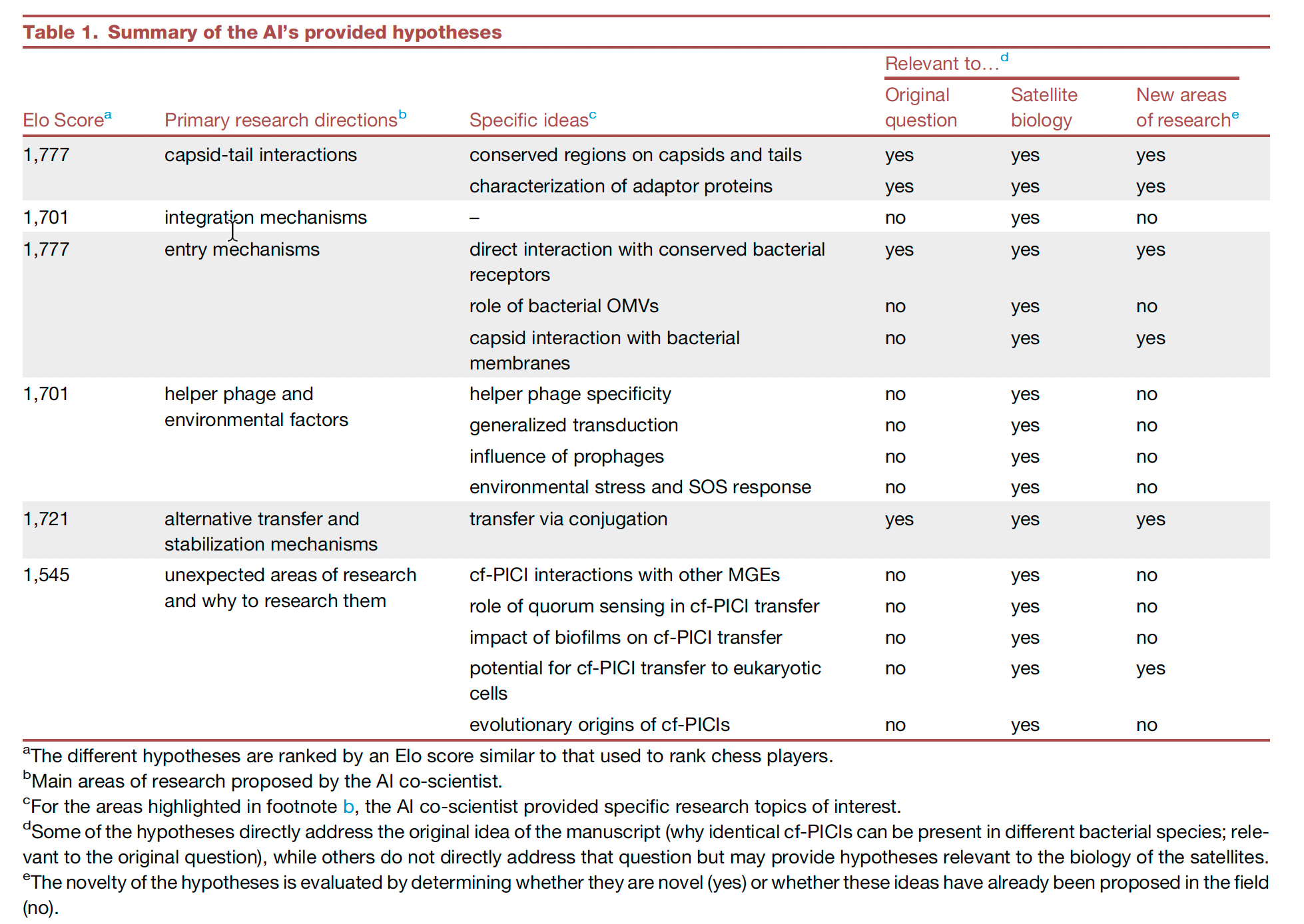
As noted, the top research direction suggested by CoScientist was experimentally shown to be the correct one. But Penades thought that some of the alternative ideas were creative and most significantly, testable. Some were less novel (see New Areas of Research column in table), but others have stimulated their thinking to pursue new directions for satellite biology.
They provided the same information to 7 other agents (e.g., Gemini 2.0 Pro Experimental, OpenAI deep research, Claude Sonnet 3.7 and DeepSeek-R1) and none were able to generate ideas regarding capsid-tail interactions. Hence, AI-CoScientist has some particular properties [however, note that the computation process requires several days rather than minutes for the other agents].
I thought that Penades et al., as experimental scientists, made some important points regarding the future use of AI agents:
If the ‘conventional wisdom’ within a specific subdiscipline is limiting humans’ creativity, AI agents may identify novel approaches. I loved doing multidisciplinary research for this reason – scientists from other disciplines viewed different facets of a problem than I did. Novelty could arise from integrating disparate views and approaches.
These AI agents may very well generate novel ideas and many may be theoretically possible. However, they require critical oversight by expert scientists as the agents lack contextual judgment.
I worry a bit about the use of these agents for training the next generation of scientists. Will they be a crutch that inhibits development of ‘contextual judgment’ or an aid that permits more opportunities to consider context?
Hypotheses
Penades et al. referred to CoScientist’s “hypotheses.” If I look at the output, they feel more like research directions. (Although this may be a consequence of how they reported the outputs; the specific ideas in the table above could be reformulated as formal hypotheses). This is a very key point for the value of these agents for future research. As Jim Prosser has pointed out much of published microbial ecology research is now hypothesis-free. In another important paper, he addressed the philosophy of doing experimental microbial ecology.
As I am not an expert in satellite biology, I cannot assess how deep or ‘risky’ (sensu Popper) are hypotheses CoScientist developed. That Penades finds them ‘testable’ (falsifiable) is certainly a mark in their favor.
For future uses of this tool, I think including a philosopher of science in the development process would be highly valuable. That individual could be tasked with ensuring that words in prompts are used precisely (see my post on Mechanism). Refining the output so that it produces testable, risky hypotheses rather than general research directions would be very valuable to experimental scientists who appear to rarely think deeply in such terms. In that fashion, an AI agent such as this can help meet Prosser’s challenge:
“be brave enough to look for interesting but maybe difficult questions, propose bold and risky hypotheses, test them critically and be prepared for them to fail. This, rather than relentless, aimless accumulation of data, has and will provide real advances in microbial ecology.”
Today’s Moment of Zen
In between watching World Cup matches, I have enjoyed working on images I took on my Danube cruise through southeastern Europe.
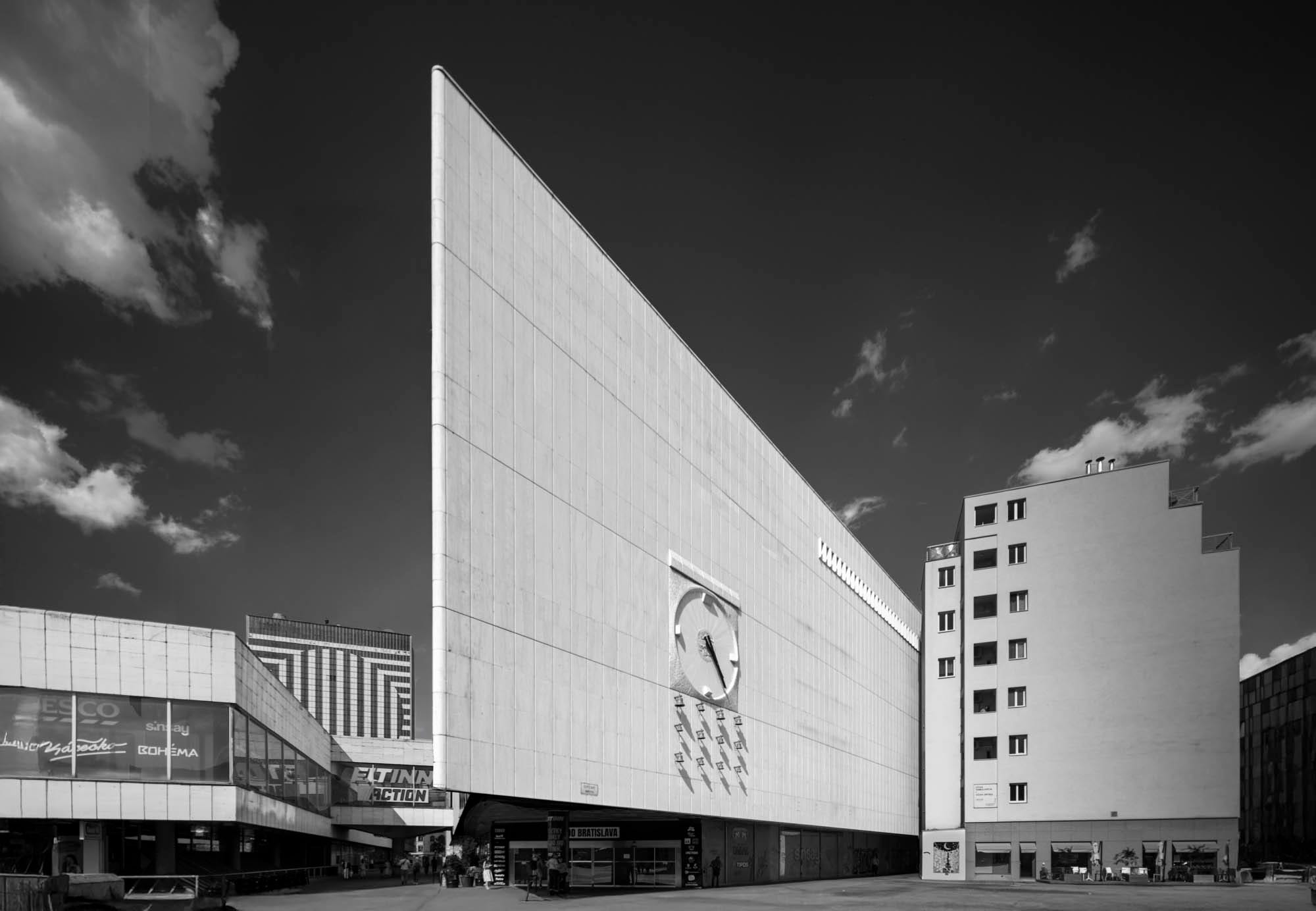
This was an interesting shopping complex in Bratislava, Slovakia. The striking Monolith (Obchodný dom Prior) with clean, unyielding geometric lines was designed by Ivan Matušík and built in the 1960s. The panels of Slovakian Spiš travertine contrast with the bold lines of the structure and the embedded marble clock provides a central focal point.
Wonderful post Allan, and always great to hear your perspective. There is certainly risk that AI might become a crutch, leading to cognitive offloading, but used deliberately, AI may turn out to be the most wonderful teacher, improving critical thinking and creativity - helping us make connections we never thought to seek, validated by ones we did (e.g., your Penades example). I believe it's how we use these tools is what matters, and to guide coming generations to interact effectively with AI, we'll need a human-in-the-loop.
Maybe AI Co-Scientists will also help solve the issue Jim Prosser pointed - and guide scientists away from publishing under-reasoned scientific findings.
Enjoy the football!!!